ElectronsX > Supply Chains > EV Supply Chain > Motor & Drivetrain Supply Chain
Motor & Drivetrain Supply Chain
The motor and drivetrain supply chain converts battery energy into motion - wheel torque, acceleration, gradeability, towing capability, and sustained performance. It sits at the intersection of critical minerals, rare earth processing, advanced materials, precision manufacturing, power electronics, thermal management, and software control.
Unlike internal combustion drivetrains, electric drivetrains compress value into a smaller number of high-performance components. That simplification at the vehicle level relocates complexity upstream into refining, magnet production, motor design, inverter control, and highly integrated propulsion assemblies. The motor supply chain is not just a component category - it is a performance stack, and one of the clearest examples of how electrification shifts industrial value and geopolitical dependency.
Cross-Sector Deployment
The same upstream supply chain that produces EV traction motors also feeds wind turbine generators, humanoid robot actuators, industrial servo drives, drone propulsion systems, and marine propulsion. NdFeB permanent magnets, GOES electrical steel laminations, copper windings, and brushless motor architectures are shared across all these domains - making the motor supply chain one of the highest-convergence nodes in the electrification ecosystem.
| End Market | Motor Type | Key Materials | Primary Demand Driver |
|---|---|---|---|
| EV Traction | PMSM, IPM, induction, wound rotor | NdFeB magnets, GOES laminations, hairpin copper, SiC inverters | Torque density, efficiency, 800V compatibility, e-axle integration |
| Wind Turbine Generators | PMSG direct-drive, DFIG | NdFeB magnets (large-format), electrical steel, copper windings | High pole count, low-speed torque, multi-MW output |
| Humanoid Robot Actuators | Brushless servo, quasi-direct drive, linear actuators | NdFeB magnets (compact high-energy), harmonic drives, GaN joint drives | Torque-to-weight ratio, backdrivability, precision positioning |
| Industrial Robots & Servo | AC servo motors, PMSM | NdFeB magnets, electrical steel, precision encoders | Position accuracy, cycle speed, thermal stability |
| Drones & UAVs | Brushless outrunner motors, ESC-driven | NdFeB magnets, aluminum housings, GaN ESC power stages | Power-to-weight ratio, KV rating, thermal management at altitude |
| Marine Propulsion | PMSM pod drives, rim-drive thrusters | NdFeB magnets, marine-grade copper, corrosion-resistant housings | Efficiency at low speed, saltwater hardening, reversibility |
Why the Motor Supply Chain Matters
The motor and drivetrain supply chain is a material-to-motion stack. It is not just about assembling a motor at the end of the line - it is about aligning mineral inputs, advanced materials, precision components, control electronics, and manufacturing execution into a scalable propulsion architecture. A weak link in rare earth refining constrains magnet output. A magnet supply disruption forces motor redesign. A motor architecture shift alters inverter requirements, gearbox ratios, thermal management, and vehicle packaging.
| Domain | What It Does | Why It Matters | Primary Strategic Pressure |
|---|---|---|---|
| Rare earth refining | Processes rare earth ores into neodymium and praseodymium compounds | Permanent magnet motor performance and supply security begin here | Geographic concentration, processing complexity, environmental burden |
| Magnet manufacturing | Converts refined materials into high-performance permanent magnets | Torque density, compactness, and efficiency depend on magnet quality | Supply concentration, cost volatility, temperature-performance tradeoffs |
| Motor manufacturing | Builds the electric machine using laminations, copper, shafts, bearings, sensors | The motor is the core electromechanical converter in the drivetrain | Automation quality, material cost, manufacturing precision |
| E-axle integration | Combines motor, reduction gear, differential, and inverter-adjacent functions | Integration affects mass, packaging, efficiency, and service strategy | Thermal density, manufacturability, supplier dependency |
| Power control unit | Controls electrical power flow between battery, inverter, motor, and systems | Drivetrain is only as effective as its control and power-conversion layer | Semiconductor supply, thermal management, software calibration |
The Material-to-Motion Stack
Understanding the motor supply chain requires tracing it from mine to motion. Each stage affects the next - and a disruption at any stage cascades through the entire stack.
| Supply Chain Stage | Representative Activities | Downstream Dependency | Failure Impact |
|---|---|---|---|
| Mineral extraction & separation | Mining rare earth ores, separating critical elements from mixed feedstocks | Elemental basis for permanent magnet materials | Constrained magnet supply and reduced sourcing resilience |
| Refining & chemical conversion | Converting separated materials into oxides, metals, and magnet-grade feedstock | Consistent magnetic performance and manufacturability | Impure feedstock, lower yield, higher cost, weaker performance |
| Magnet production | Alloying, sintering, machining, coating, magnetizing permanent magnets | Rotor magnetic properties and motor compactness | Lower torque density or forced redesign of motor architecture |
| Motor & rotor-stator manufacturing | Building stators, rotors, windings, housings, electromechanical assemblies | Core propulsion machine | Efficiency loss, NVH issues, durability problems, throughput bottlenecks |
| Drive-unit integration | Integrating motor with gearbox, differential, cooling, sensors, power electronics | Deployable propulsion module | Assembly complexity, heat problems, packaging penalties, warranty risk |
| Power & software control | Inverter control, torque mapping, protection logic, regen braking management | Real-world drivetrain behavior | Poor drivability, inefficiency, thermal derating, safety margin erosion |
Rare Earth Element Refining
Permanent magnet synchronous motors (PMSM) dominate EV traction because they deliver strong torque density, compact packaging, and high efficiency across a wide operating range. Those advantages depend on access to neodymium, praseodymium, and often dysprosium or terbium for high-temperature performance. The supply chain challenge is not mining - it is refining and chemical conversion. Rare earth refining is difficult, energy-intensive, chemistry-heavy, and geopolitically concentrated. Even when raw ore exists elsewhere, refining and downstream conversion capacity remains concentrated in relatively few locations - making motor supply resilience fundamentally a refining problem, not just a mining problem.
| Refining Layer | Role in Motor Supply Chain | Why It Matters | Strategic Risk |
|---|---|---|---|
| Rare earth separation | Separates individual REEs from mixed concentrates | Motor magnets require specific elements at usable purity levels | Complex processing and limited global capacity outside China |
| Oxide & metal production | Converts separated elements into forms suitable for magnet manufacturing | Material consistency affects downstream magnetic performance | Purity control, yield loss, environmental processing burden |
| Alloy feedstock preparation | Creates feed materials for high-performance magnet alloys | Directly influences temperature capability and torque density | Supply shocks cascade into motor redesign or cost spikes |
Magnet Manufacturing
Refined rare earth materials become drivetrain value only when converted into usable magnets. Magnet manufacturing involves alloying, pressing, sintering, machining, coating, magnetization, and quality control. These steps determine magnetic strength, corrosion resistance, dimensional accuracy, and long-term behavior under thermal stress. A better magnet system helps an OEM achieve more torque from a smaller package, improve efficiency, and reduce the space required for the propulsion unit. China produces approximately 90% of global NdFeB magnets - the most significant single supply chain concentration in the EV motor stack.
| Manufacturing Step | Purpose | Impact on Motor Performance | Common Constraint |
|---|---|---|---|
| Alloy formation | Creates the magnetic composition for target performance | Affects magnetic strength, temperature stability, efficiency | Feedstock quality and precise composition control |
| Sintering & shaping | Forms dense permanent magnets into usable geometries | Influences magnet consistency and final packaging precision | Yield, brittleness, and process precision |
| Machining & finishing | Brings magnets to exact size and tolerance | Improves rotor integration and air-gap control | Material fragility and scrap risk |
| Coating & protection | Protects magnets from corrosion and environmental degradation | Supports long-term durability in harsh environments | Coating reliability under thermal cycling |
| Magnetization & QC | Establishes and verifies final magnetic properties | Determines consistency from one motor to the next | Throughput, testing fidelity, rejection cost |
Motor Manufacturing
Motor manufacturing combines advanced materials with precision electromechanical assembly. Whether the design uses permanent magnets, induction architectures, or wound rotor variants, the factory challenge is the same: produce high-efficiency, high-reliability machines at scale with tight thermal, mechanical, and electrical tolerances. Small defects in winding placement, rotor balance, lamination quality, or bearing fit degrade efficiency, increase vibration, generate noise, or shorten life. Motor manufacturing is both a materials problem and a process-control problem.
| Manufacturing Layer | Representative Inputs | Why It Is Important | Main Challenge |
|---|---|---|---|
| Laminations | GOES electrical steel, stamped lamination stacks | Determines magnetic losses, efficiency, and machine behavior | Precision stamping, stack consistency, GOES supply constraint |
| Windings | Copper conductors, insulation, hairpin or distributed winding | Influences current handling, heat generation, and power density | Automation quality, weld integrity, insulation durability |
| Rotor system | Magnets, shaft, retention features, balancing | Converts electromagnetic forces into torque-producing rotation | Balance precision, magnet retention at high RPM, thermal management |
| Bearings & housings | Precision bearings, aluminum or cast iron housings, seals | Supports rotor, manages radial and axial loads, seals cooling system | NVH, bearing life under EV duty cycles, housing integration complexity |
| Cooling integration | Cooling jackets, oil spray systems, stator cooling channels | Sustained power output and peak torque depend on heat rejection | Sealing, thermal interface to inverter and gearbox, coolant routing |
E-Axle & Drive Unit Integration
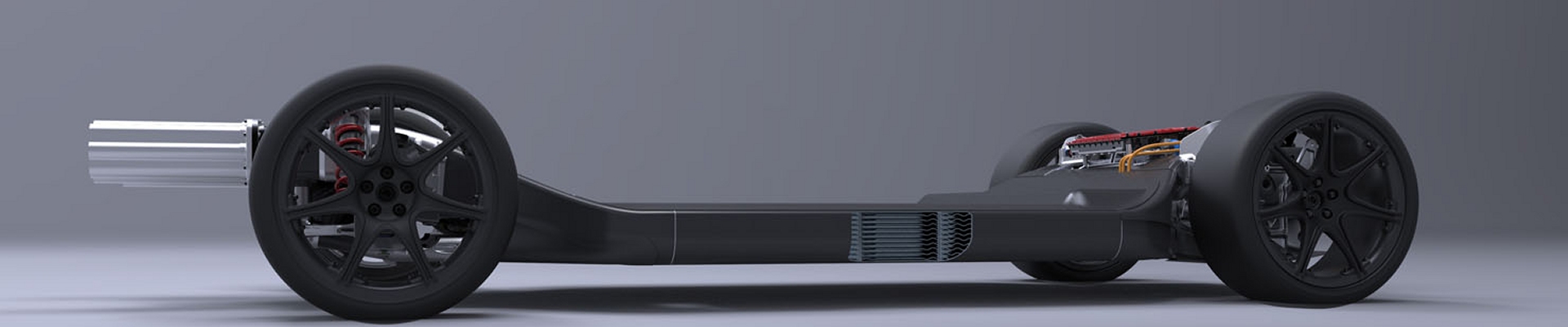
The e-axle integrates motor, reduction gearbox, differential, and often power electronics interfaces into a single compact propulsion module. This integration trend is reshaping the drivetrain supply chain - moving value from individual component suppliers toward integrated drive unit assemblers. Key e-axle suppliers include BorgWarner, ZF, Magna, Nidec, Vitesco, and increasing in-house production from Tesla, BYD, and Chinese OEMs.
E-Axle & Integration Supply Chain
GOES Electrical Steel - The Hidden Chokepoint
Grain-oriented electrical steel (GOES) is required for EV traction motor laminations, transformer cores for gigafactory energization, and grid infrastructure transformers. The same material is demanded simultaneously by EV manufacturing scale-up, gigafactory construction, and grid buildout - and US domestic GOES production capacity is insufficient to serve all three concurrently. GOES supply is one of the least-discussed but most consequential chokepoints in the entire electrification supply chain. It is a convergence node where EV, gigafactory, and grid supply chains directly compete.
See: Supply Chain Convergence Map
Robot Actuators - Where the Motor SC Diverges
Humanoid and quadruped robot actuators share the upstream motor supply chain through NdFeB magnets and brushless motor architectures, but diverge sharply at the gearbox layer. Robot joints require harmonic drives and strain-wave gearboxes for backdrivability and precision - components with no direct EV equivalent. Harmonic Drive Systems and Nabtesco (Japan) dominate global supply, with Chinese OEMs scaling rapidly. This is the robot supply chain's equivalent of the SiC wafer problem - a highly concentrated component that gates an entire platform category.
Humanoid & Robot Supply Chain
Actuator Supply Chain
Actuator Power Electronics
Related Coverage
- REE Refining for Magnets
- Magnet Manufacturing for Motors
- Traction Motors & Magnets
- EV Power Control Units (PCU)
- Upstream Materials
- Battery Supply Chain
- Power Electronics
- Thermal Systems