EV Directory > Renault Portfolio
Renault EV Portfolio
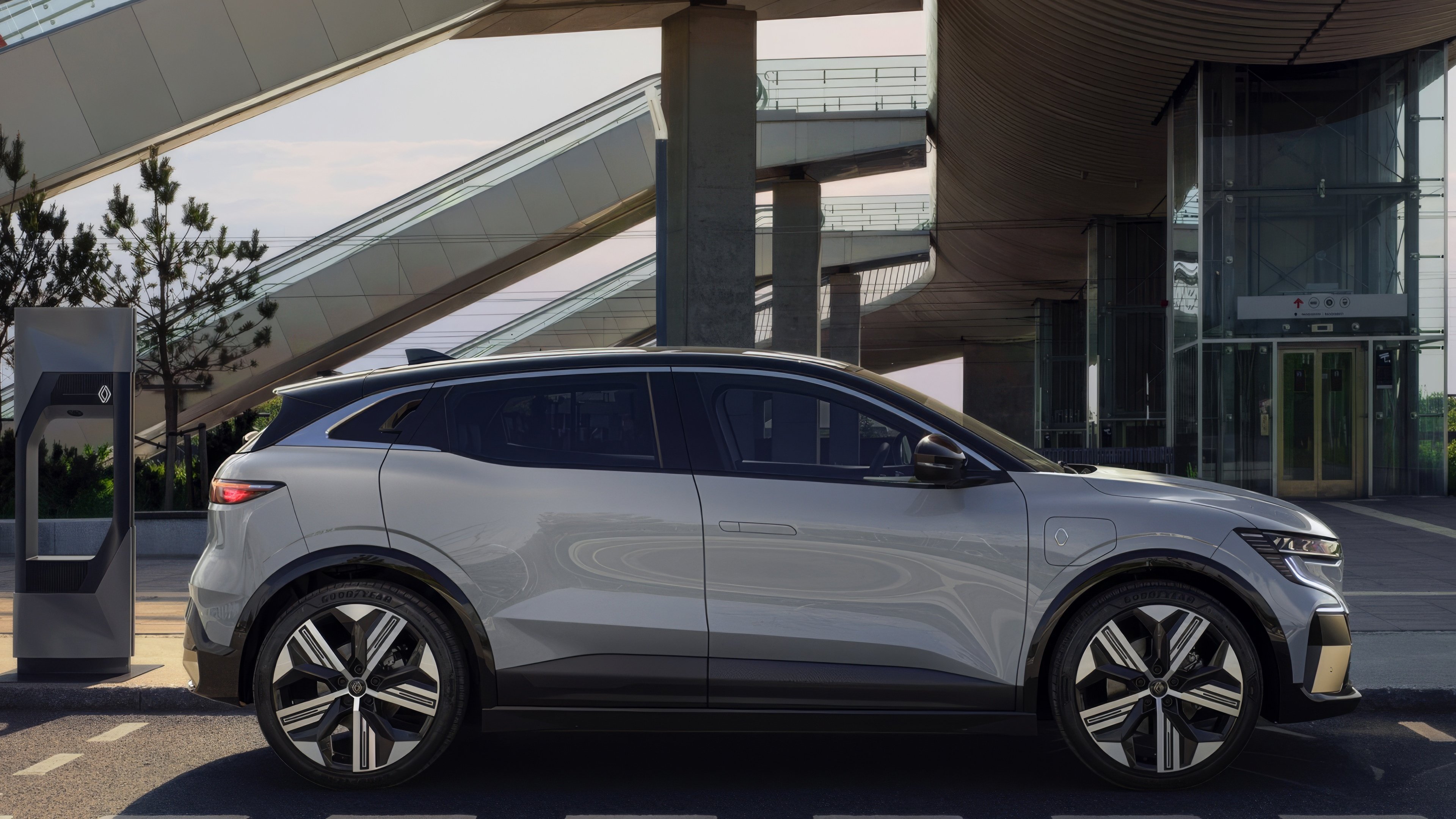
Renault is an EV brand owned by Renault-Nissan-Mitsubishi and made in France. This model portfolio showcases the shift toward zero-emission mobility.
Vehicles are organized by model family. A model family is an OEM-defined product program sharing a common platform, architecture, and market positioning, from which multiple body styles, variants, and trims are derived.
Renault EV Model Families
List of Renault EV model families - only all-electric (BEV) models are listed:
| Canonical Model | Variants | Style |
|---|---|---|
| Renault 4 E-Tech | 40 | SUV |
| Renault 4 E-Tech | 52 | SUV |
| Renault 5 E-Tech | ER | hatchback |
| Renault 5 E-Tech | SR | hatchback |
| Renault Kangoo E-Tech Electric | MPV | |
| Renault Master E-Tech | LR | MPV |
| Renault Master E-Tech | SR | MPV |
| Renault Megane E-Tech | EV40 | SUV |
| Renault Megane E-Tech | EV60 | SUV |
| Renault Scenic E-Tech | 60 | SUV |
| Renault Scenic E-Tech | 87 | SUV |
| Renault Traffic E-Tech | MPV | |
| Renault Twingo E-Tech | hatchback |
Renault EV Technology
Platform: Shared, 400VE/E Architecture: Baseline
OTA Capability: Baseline
Battery Suppliers: AESC, CATL
Power Inverter Tech: IGBT-based
Platform = level of vehicle platform maturity or advancement, and its dominant system voltage.
Shared = ICE-derived | Dedicated = EV-native platform | SDV-Native = future-proof
E/E Architecture: degree of integration and maturity of the vehicle’s electronic/electric control systems (from Baseline legacy wiring to Advanced domain/zonal designs).
Baseline = Distributed ECUs | Modern = Domain-based | SDV-Native = Zonal-based with central compute
OTA Capability = scope of Over-The-Air updates supported — from Baseline basic infotainment to Advanced control and systems firmware.
Baseline = Infotainment/maps | Limited = Infotainment+ | Partial = Multiple systems | Advanced = Most systems | Full = Full-vehicle updateable
Battery Suppliers = primary traction battery suppliers across the model lineup.
Power Inverter Tech = power electronics technology used (silicon carbide SiC vs silicon), which affects efficiency and thermal performance.
IGBT = Conventional | SiC = High-efficiency | GaN = Next-generation, pilots
Renault electric vans & MPVs
| Model |
|---|
| Renault Kangoo E-Tech |
About Renault
Renault is a French multinational automaker headquartered in Boulogne-Billancourt, Paris, and one of Europe's oldest and most influential vehicle manufacturers. Founded in 1899, Renault has long been recognized for innovation, mass-market accessibility, and engineering excellence. Today, the company stands as a global leader in electrification through its early EV investments and its alliance with Nissan and Mitsubishi, forming one of the world's largest automotive partnerships. Renault's strategic vision, Renaulution, is centered on transforming the company into a next-generation, software-defined, electric mobility brand.
Renault began its modern EV journey with the launch of the Renault ZOE in 2012- one of Europe's best-selling electric vehicles for nearly a decade. Built on the Renault-Nissan Alliance platform, the ZOE combined a 52 kWh battery with a range of up to 395 kilometers (WLTP), making it the cornerstone of Renault's early success in urban electrification. Alongside the ZOE, Renault introduced the Kangoo Z.E. and Master Z.E., pioneering all-electric light commercial vehicles (LCVs) for city logistics long before many competitors entered the space.
Renault's next-generation BEV strategy builds on this foundation with a complete family of electric models developed under the new AmpR Small (formerly CMF-BEV) and AmpR Medium (formerly CMF-EV) platforms. Leading this new wave is the Renault Mégane E-Tech Electric, launched in 2022. Built on the AmpR Medium platform shared with the Nissan Ariya, the Mégane E-Tech features a 60 kWh battery, up to 470 kilometers of WLTP range, and 130 kW DC fast-charging capability. It combines compact crossover proportions with high digital integration, including an Android Automotive OS-based infotainment system and over-the-air software updates.
The upcoming Renault 5 E-Tech Electric revives one of the brand's most iconic models in fully electric form. Built on the AmpR Small platform, the Renault 5 offers up to 400 kilometers of range with a 52 kWh battery and advanced regenerative braking for city driving. A companion model, the Renault 4 E-Tech Electric, will follow- a rugged, retro-inspired crossover version designed for adventure and versatility. Both models showcase Renault's focus on emotion-driven design and accessible pricing while incorporating state-of-the-art EV technology.
Beyond passenger vehicles, Renault is leading the transition of light commercial fleets with its Trafic E-Tech, Master E-Tech, and new hydrogen-electric variants under development. Through its Hyvia joint venture with Plug Power, Renault is integrating hydrogen fuel cell systems into its larger vans, offering extended range and zero-emission operation for professional users.
Renault's new corporate structure also separates its EV and software operations under a dedicated division called Ampere. This entity focuses exclusively on electric and digital technologies, allowing Renault to streamline development of battery, software, and connectivity platforms. Ampere will also supply technology to other Stellantis and Alliance brands, reinforcing Renault's role as an EV innovation hub for Europe.
As part of its environmental roadmap, Renault aims to achieve full carbon neutrality in Europe by 2040 and globally by 2050. It continues to invest in circular economy initiatives through the Refactory in Flins, where used vehicles and batteries are refurbished and recycled to extend material life and reduce waste across its supply chain.
Electrification Status
Renault is a leading transitioning automaker and one of Europe's earliest mass-market EV pioneers. With models like the ZOE, Mégane E-Tech, and upcoming Renault 5 and 4 E-Tech- along with its dedicated Ampere EV division- Renault combines French design heritage, digital intelligence, and industrial scale to shape the next generation of sustainable, zero-emission mobility.
