EV Directory > Mazda Portfolio
Mazda EV Portfolio
Mazda is an EV brand owned by Mazda Motor and made in Japan. This model portfolio showcases the shift toward zero-emission mobility.
Vehicles are organized by model family. A model family is an OEM-defined product program sharing a common platform, architecture, and market positioning, from which multiple body styles, variants, and trims are derived.
Mazda EV Model Families
List of Mazda EV model families - only all-electric (BEV) models are listed:
| Canonical Model | Variants | Style |
|---|---|---|
| Mazda 6e | sedan | |
| Mazda EZ-6 | liftback | |
| Mazda EZ-60 | SUV | |
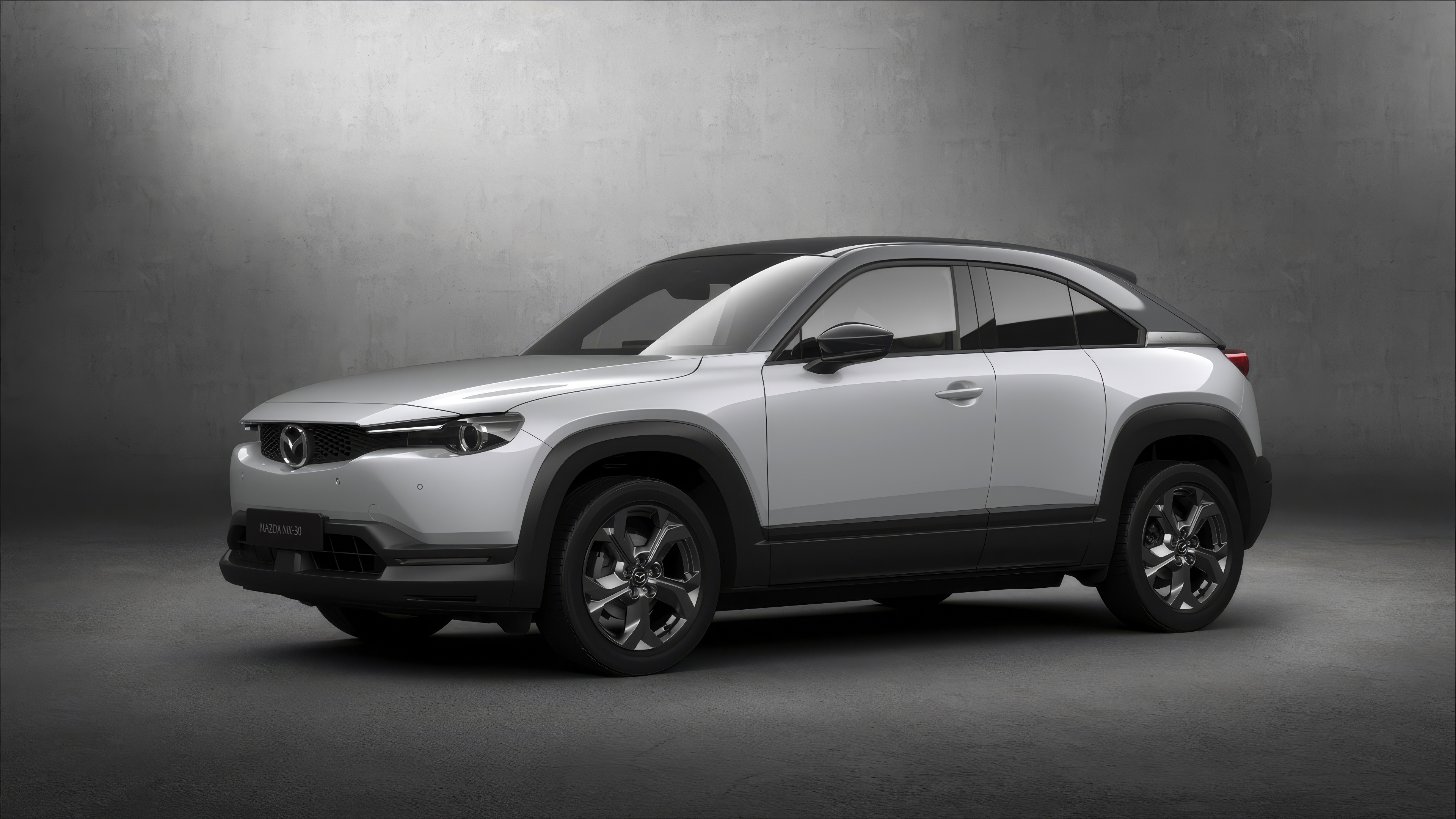
| Mazda MX-30 | SUV |
Mazda EV Technology
Platform: Dedicated EV, 400VE/E Architecture: Modern
OTA Capability: Baseline
Battery Suppliers: Panasonic
Power Inverter Tech: IGBT-based
Platform = level of vehicle platform maturity or advancement, and its dominant system voltage.
Shared = ICE-derived | Dedicated = EV-native platform | SDV-Native = future-proof
E/E Architecture: degree of integration and maturity of the vehicle’s electronic/electric control systems (from Baseline legacy wiring to Advanced domain/zonal designs).
Baseline = Distributed ECUs | Modern = Domain-based | SDV-Native = Zonal-based with central compute
OTA Capability = scope of Over-The-Air updates supported — from Baseline basic infotainment to Advanced control and systems firmware.
Baseline = Infotainment/maps | Limited = Infotainment+ | Partial = Multiple systems | Advanced = Most systems | Full = Full-vehicle updateable
Battery Suppliers = primary traction battery suppliers across the model lineup.
Power Inverter Tech = power electronics technology used (silicon carbide SiC vs silicon), which affects efficiency and thermal performance.
IGBT = Conventional | SiC = High-efficiency | GaN = Next-generation, pilots
About Mazda
Mazda Motor Corporation is a Japanese automaker headquartered in Hiroshima, Japan, known for its engineering innovation, distinctive design language, and engaging driving dynamics. Founded in 1920, Mazda has long emphasized lightweight efficiency and internal combustion optimization, most famously through its rotary engine technology. As the global auto industry transitions to electrification, Mazda is pursuing a measured, multi stage strategy that blends electrified internal combustion, hybridization, and fully electric models under a cohesive long term roadmap called the "Sustainable Zoom-Zoom 2030" vision.
Mazda's first production battery electric vehicle, the Mazda MX-30, launched in 2020. Built on Mazda's Skyactiv Multi-Solution Scalable Architecture, the MX-30 is a compact crossover featuring a 35.5 kWh battery, approximately 200 kilometers of real world range, and Mazda's signature "human-centric" handling. It was later joined by a range-extended rotary hybrid version, which reintroduces Mazda's iconic rotary engine as a compact generator to extend driving distance without compromising EV refinement. The MX-30 serves as a transitional model bridging Mazda's legacy engineering strengths with its electric future.
Looking ahead, Mazda plans to introduce several new BEVs on a dedicated scalable EV platform by the second half of the decade. The company's updated electrification roadmap includes five hybrid models, five plug-in hybrids, and three fully electric vehicles by 2026, with additional BEVs to follow through 2030. These vehicles will leverage Mazda's next generation Skyactiv EV platform and partnerships with suppliers such as Panasonic Energy for battery technology and Toyota Motor Corporation for hybrid systems.
Design remains a central focus of Mazda's identity, with its Kodo - Soul of Motion philosophy evolving for the electric age to emphasize purity, balance, and aerodynamic form. Upcoming BEVs are expected to embody minimalist Japanese aesthetics and intuitive, tactile interfaces that preserve the driver connection Mazda is known for. The brand is also investing in software-defined vehicle architectures and digital cockpit systems to enhance connectivity, personalization, and safety through OTA updates.
While Mazda's electrification pace has been slower than some competitors, its strategic approach aims to align product timing with technological readiness and market demand, ensuring that its future EVs maintain Mazda's hallmark characteristics of lightness, precision, and driving engagement.
Electrification Status
Mazda is a transitioning automaker advancing from hybrid and range-extended platforms toward a fully electric lineup later in the decade. With its dedicated Skyactiv EV architecture, next generation design philosophy, and rotary hybrid innovation, Mazda is carefully redefining its driver-focused legacy for the zero emission era.
